Tenant-scoped data
Tenant context and PostgreSQL row-level security enforce organization boundaries. Authorization checks happen on the server, alongside audit attribution.
 Limosaidentity
SECURITY & CONTROL
Make responsibility visible and keep decisions traceable. Limosa Identity separates platform permissions, governed business access and application outcomes.
Tenant context and PostgreSQL row-level security enforce organization boundaries. Authorization checks happen on the server, alongside audit attribution.
Login users and internal permissions are separate from governed identities and business roles. Business-role membership alone does not grant administration rights.
Keep policy intent, approval decisions, connector attempts and target observations distinct. Review what changed with object histories and audit records.
EXTERNAL CREDENTIAL PROVIDERS
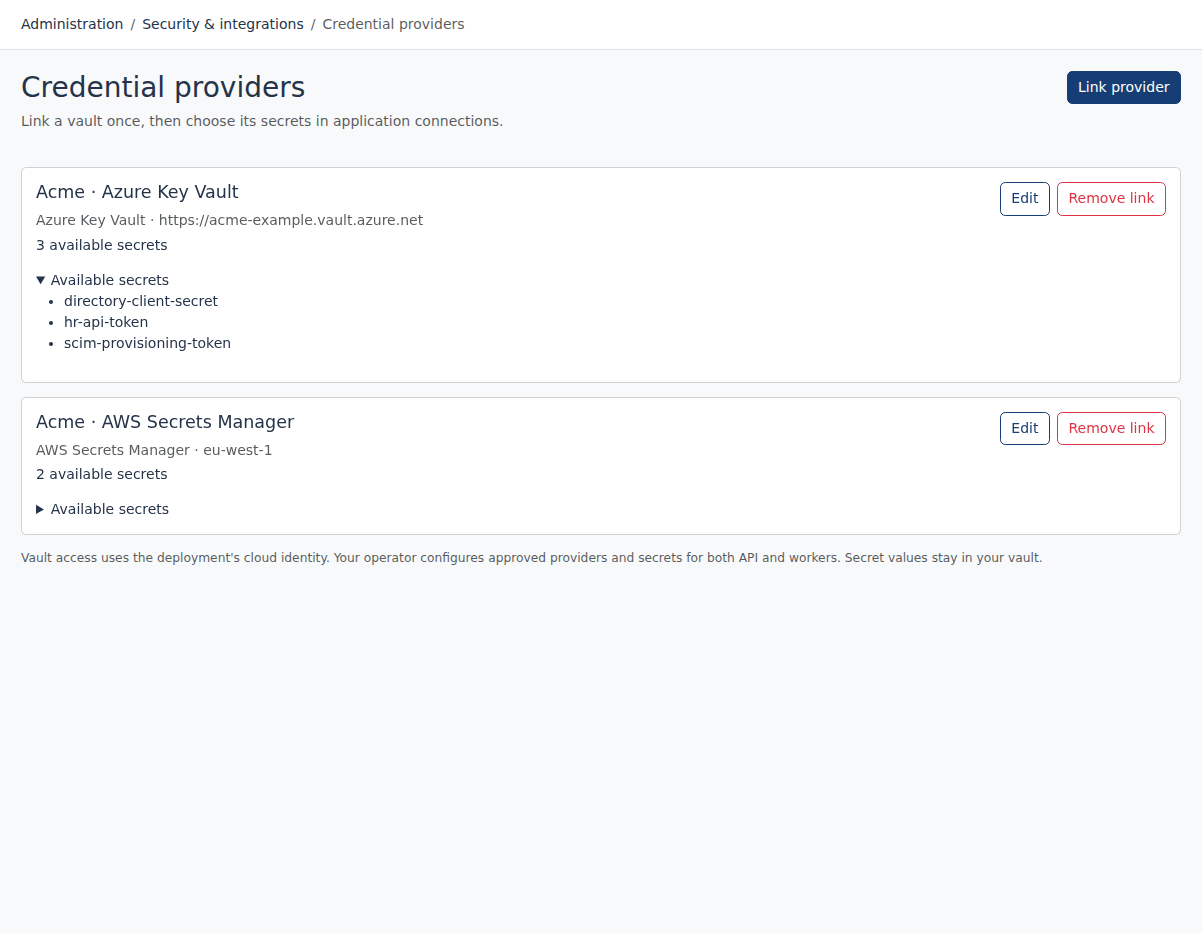
The providers pictured are synthetic examples. Deployment operators approve available providers and secret aliases; Limosa Identity reads configured secrets during execution.
A CLEAR CREDENTIAL BOUNDARY
Approve provider and aliases
Link and select references
Resolve the configured secret
Execute the supported operation
Customer JavaScript transforms execute in the separate isolated runtime with execution limits. Security configuration and live integrations require validation in your deployment.
AI & DATA HANDLING
MCP sign-in and consent connect a client to a workspace. Calls run within the consenting user’s current permissions. Connecting an assistant does not create administrator authority.
Tool results are returned to the connected assistant and may include identity data, access records or configuration within your authorized scope. The assistant provider’s processing and retention terms apply to data shared with that service.
MCP uses the same registered management operations and authorization as the web interface. Configured request and approval rules apply to those operations. Administrative writes are not automatically routed through a separate approval workflow.
Choose an assistant and organization settings appropriate for your information. Use the web interface where you do not want an external assistant involved. Review and disconnect authorized client connections when they are no longer needed.
Read client setup and full AI coverage →DEPLOYMENT RESPONSIBILITIES
| Area | What to assess |
|---|---|
| Hosting & network | Agree hosting location, access to source and target systems, TLS and administrative access for the selected deployment. |
| Data protection | Agree retention, export, deletion and backup handling for identity data, audit records and operational logs. |
| Continuity | Confirm monitoring, incident ownership, backup verification and recovery procedures with the deployment operator. |
| Credentials | Approve providers and secret references; set target permissions and rotation procedures with application owners. |
| AI services | Review the chosen client provider, data-processing terms and authorized users before connecting production data. |
Implementation controls do not establish a certification, tested recovery objective or availability commitment. Confirm deployment-specific evidence and contractual commitments during evaluation.
SECURITY & PROCUREMENT REVIEW
Request the security, privacy and contractual information your organization needs. Specify requirements for data location, subprocessors, processing terms, assessment evidence and support. Availability and scope of documents will be confirmed; this website does not claim an ISO or SOC certification.
YOUR NEXT STEP
Explore the public demo or bring your applications and governance questions to a guided conversation.